
Data Providing Institutions
SPHN Connector
The SPHN Connector is a tool for data providers to transform data from the local source into validated RDF data including de-identification and validation of the data.
The SPHN Connector is a tool for data providers to transform data from the local source into validated RDF data including de-identification and validation of the data.
SPHN Connector
The SPHN Connector is a tool for data providers to transform data from the local source into validated RDF data including de-identification and validation of the data.
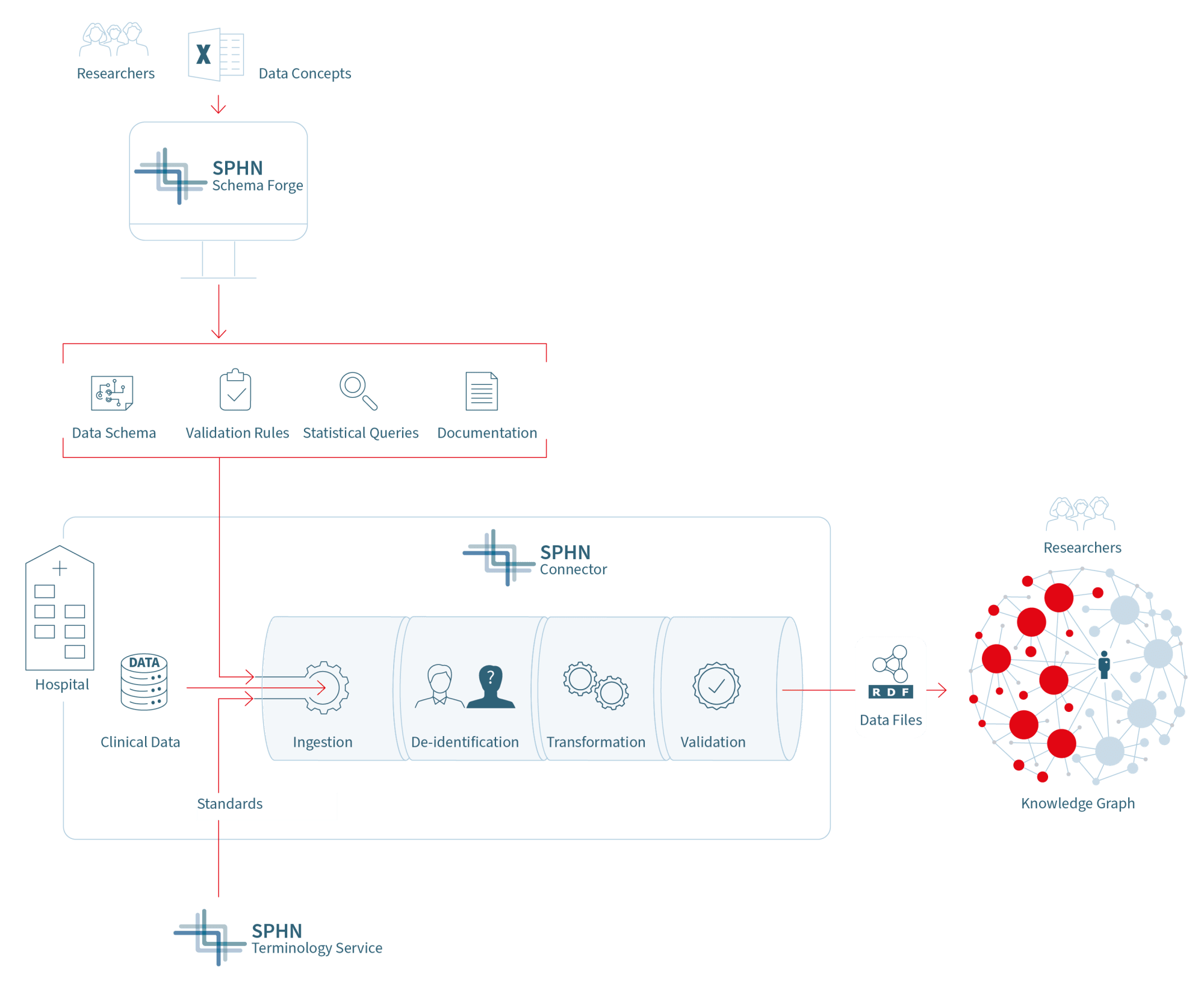
SPHN Connector - An Overview
Watch the SPHN Webinar introducing the SPHN Connector.
Clinical data are stored in diverse formats and database systems
Data providers in the SPHN network use a variety of database systems to store their clinical data. Data is stored in diverse formats (e.g. structured SQL databases. Validating data quality is difficult to manage with large amounts of data, and is sometimes regarded as time-consuming and resource-intensive, delaying the work that researchers need to achieve.
What is the SPHN Connector?
The SPHN Connector is a containerized solution that allows data-providing institutions to build a pipeline that converts their data from relational or JSON sources into graph data based on a RDF schema conforming to the SPHN Framework. The ingested data is converted into RDF and validated to check its conformity with the schema. Optionally, data providers that do not have an in-house de-identification functionality, can activate the module for de-identification in the SPHN Connector.
Compatibility of the SPHN Connector with data provider IT systems
The SPHN Connector integrates a variety of tools developed or distributed by SPHN like the SHACLer or the SPHN RDF Quality Check Tool to simplify the production of high quality data. In the context of SPHN, the SPHN Connector is intended to and can be used by any data provider for an easier creation and validation of data in RDF.
The SPHN Connector is built with flexibility and simplicity in mind. It requires only two inputs: The patient-level data and the base schema which can be the SPHN RDF Schema and optionally a project-specific RDF Schema.
Almost everything else can be adapted by the user to fit its needs and skills, and the working environment. One example is the variety of input data that is supported by the SPHN Connector: a user can upload JSON files, RDF files or setup a specific database import. The user also has the option to configure validation parameters. Experienced users can provide their own SHACL file for validation, while others can simply use the file that is created by the SPHN Connector via the SHACLer.
The SPHN Connector provides the user with an entire pipeline for creating and validating patient data using Semantic Web technologies.